Grounding Mindfulness Exercises for Everyday Moments
Having ways to ground ourselves can change how we experience our day.
We might notice a beautiful blooming tree or birdsong, stay a little longer in a conversation, or actually be there for a meal we’re sharing with someone. These are all small moments that are easy to be absent for. And when we continuously miss them, well then, we’re missing a lot.
Grounding isn’t complicated. It can be a micro-moment, like coming back to your body before getting out of your car. Or, it can be a few minutes you set aside to spend a bit more time cultivating it.
The grounding mindfulness exercises I describe in this blog post include both. The first few are meant for brief check-ins, while the later ones are for building your present moment awareness more intentionally.
Start wherever feels most accessible.
In-The-Moment Grounding Mindfulness Exercises
The following are mindfulness practices that can be used in the moment, whenever you feel the need to come back to yourself and your surroundings. Some just take a few seconds, while others a few minutes. Each one is meant to be accessible and easy to return to.
5-4-3-2-1
Background:
This one is a bit of a mindfulness classic. You’ll be working with your senses on this one, as each number corresponds to noticing your surroundings through a different sense. Feel free to replace any sense that’s not accessible to you, with another one that is.
You may come across slightly different versions of this one, with the numbers not always corresponding to the same senses. Swapping things around is fair game here. I’m all for making a practice your own, as that can help you develop consistency.
How to Do It:
Pause and become aware of your surroundings.
Name, either aloud or to yourself, 5 things you can see around you.
Then, bring your attention to four things you can feel, using your sense of touch to connect with each of them. This could be physical objects you can hold, your clothes against your skin, your feet against the ground, or even your heart beating within your chest. If you’re holding something, take a moment to notice its shape, texture, or weight.
Next, tune into 3 things you can hear, letting yourself listen to each sound before moving onto the next.
Then, using your sense of smell, notice 2 things you can smell.
Lastly, if possible, connect to 1 thing you can taste. Often this means noticing a taste that has been left behind in your mouth after your most recent meal.
Take your time with this one, allowing yourself to become more present as you go.
If You Want to Modify It:
Don’t have time for the full practice? Pick one sense and connect to yourself and your surroundings through that sense.
Why I Use It:
Connecting to ourselves and the world around us through our senses is a great way to step away from anxious or ruminating thoughts, and to bring ourselves back to what’s happening right now. It’s often a practice used with children, but I think it’s very useful for us adults as well, if we’re willing to give it a try.
Feeling Your Feet
Background:
I often relate this grounding mindfulness exercise to something I once heard: Be where your feet are.
It brings me back to the idea that our body is always in the present. So if you want to bring your mind to the present moment, shifting your attention to your body is a very useful place to start.
How to Do It:
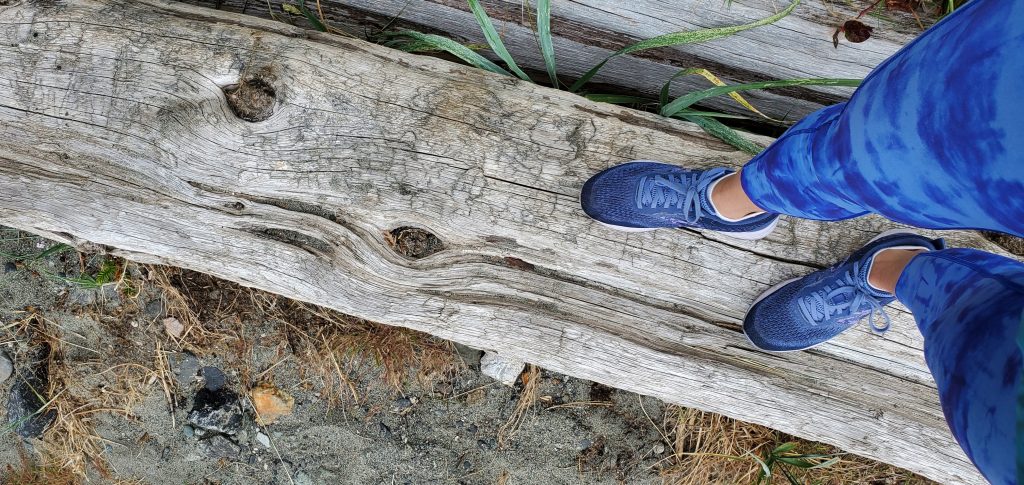
Bring your attention to your feet. You may wish to wiggle your toes, shift your weight from side to side, or front to back, in order to more clearly connect to them.
Notice any sensations that might be present. This might include the feeling of your socks or shoes against your feet, your feet in contact with the ground, or the ground in contact with your feet.
Keep in mind that sometimes sensations are obvious, sometimes subtle, and sometimes absent altogether. Your experience may be different each time.
There’s no set time for this practice. It could range from a brief moment before you step into a room, to a couple minutes if you want to stay with the experience longer.
If You Want to Modify It:
If you’re unable to sense your feet, you can do a similar exercise by connecting to your hands on your thighs, or by noticing any part of your body that’s in contact with a solid surface.
Why I Use It:
It’s theoretically simple and doesn’t take a lot of time. When I sense my feet against the ground, I find it quite grounding. It not only reconnects me to the here and now, but also to my connection to the earth, as well as to gravity holding me there.
It’s a helpful practice particularly if connecting to your breath feels inaccessible or uncomfortable.
Take-5 Breath Exercise
Background:
This is a practice that I learned through the Mindfulness Ambassador Program and teach regularly. It’s simple, as long as you’re comfortable connecting with your breath, as this is the main focus of this short practice.
How to Do It:
This practice can be done in one of 3 ways:
Pause what you’re doing and find a quiet space. Seated, standing, or lying down – whatever works best in the moment.
Turn one hand to face palm-up, resting it on your lap if you’re seated.
Bring your awareness to your breath and observe how you’re feeling. After 2 or 3 breaths, begin to count each breath. After each inhale and exhale cycle, fold one finger into the centre of your palm.
Once all 5 fingers are folded in, release the hand. Take a few more moments to stay with your breath, noticing how you feel.
The same described above can be done in a moretactile way: use one finger to slowly trace your other hand, starting at the wrist, at either the thumb or pinky side.
As you inhale, travel up one finger, as you exhale, come down the same finger.
Thirdly, if you need something more subtle: you can count 5 breaths in your head. This allows the practice to truly be done anywhere, as no one will know that you’re actually doing it.
If You Want to Modify It:
There’s no reason why it can’t be a “Take-10” practice, if you can make the time in the moment. If your intention is to feel settled, rather than just check-in, you may need more than 5 breaths. So if you have the time – go for it!
Why I Use It:
It’s a great one to have in your “back pocket”, so-to-speak, because you really can use it anytime. The tactile counting versions can be great for when your ability to focus is low, as they provide your attention something additional to anchor to, on top of the breath.
Beyond connecting with our breath, this practice can also show us how we relate to this exercise, such as whether we’re rushing, or how we interpret our ability to stay focused on the breath. In this way, it’s valuable for quietly teaching us a bit about our own patterns.
As a physiotherapist, I’ve had many conversations about posture over the years. While I no longer subscribe to the idea that posture needs to be “fixed”, I do believe that finding a centered position can have great impact on our level of alertness and presence. This is why many guided meditations invite us to come into a lengthened position. Starting this way gives us a better chance of staying with the practice.
How to Do It:
This grounding mindfulness practice can be done seated or standing.
Start by bringing your attention to your body and how you’re taking up space. Notice if any judgments or urges to “fix” your posture arise.
Then, ground yourself by feeling your feet against the ground, and your hips against your seat. Allow the weight of your body to settle into those areas. You might also tune into your exhales here, as they can help you connect to that sense of contact and support.
Next, lengthen your spine, from the tip of your tailbone through to the base of your neck, bringing space between your vertebrae. Tuning into the natural lift of each inhale can support the lengthening of your torso.
Then, create a sense of width across your body, like you’re unrolling a poster from side to side. This might mean widening across your collar bones, opening up your ribcage, or creating space across your hips.
Try to maintain softness throughout, especially if you notice yourself becoming rigid.
Once you’ve layered in all the pieces, notice how you feel in this centered position.
If You Want to Modify It:
You can also use a shorter version by focusing on the essentials: feeling your feet and your seat, lengthening your spine, and then connecting to your breath to support this grounding and lengthening.Even in its simpler form, the intention is still to come back in contact with your body and into a more connected way of being.
Why I Use It:
Not only can slight shifts in how we hold ourselves impact our level of alertness and presence, but they can also impact our mood and confidence. In turn, this can impact how we interact with others. It’s worth experimenting with, and noticing what changes for you. Who knows, you might even tell your physiotherapist that you have good posture!
Mantras don’t often resonate with me, particularly ones that I didn’t come up with myself, or don’t know the meaning of. This one, though, when it was shared with me by Dr. Arlene MacDougall, Founder of Global Minds Collective, landed deeply. It’s simple, but profound. It’s about staying with what’s already here.
How to Do It:
Repeat “I am here”, either aloud or quietly to yourself, as a way of anchoring yourself in the present moment.
This could be used in conjunction with a practice where you’re centering your awareness on your breath, when you’re supporting yourself or someone else in a difficult moment, or anytime you notice yourself getting pulled into the past or the future.
If You Want to Modify It:
My belief is that mantra phrases are most powerful when they resonate with you. So if this one doesn’t, or doesn’t in a given moment, don’t force it. Allow another phrase to emerge. I take this same approach with loving-kindness practices, altering the words so they fit what feels true in that moment.
Why I Use It:
I find it to be such a supportive phrase to repeat gently when I notice myself trying really hard to give someone advice or to fix a situation for them, or when I don’t know what to say to someone who needs me to be there with them. It reminds me that the most important thing in those moments is that “I am here”, that my presence is enough. It’s a way of staying with what’s here, rather than trying to change it.
Arriving Practice (O.M.G)
Background:
I learned this practice through the Mindful Self-Compassion program. It was a short practice that was used when we returned from a break in the class. The intention was to help us settle back into the space and class, as well as to reconnect back with our intention for being there.
How to Do It:
A helpful way to remember the steps of this practice is the mnemonic O.M.G.:
O: orient yourself to your space. Look around and take in what’s there: objects, empty space, light, location of windows and doors.
M: movement – invite movement into your body to re-establish attention in your physical experience. This might be shrugging your shoulders, rotating your torso, shifting your weight in your chair, or wiggling your toes.
G: ground – anchor further by feeling the soles of your feet against the ground, and your seat in your chair. Take a few intentional breaths.
Bonus – take a moment to reconnect with your intention for the day, or for the next moment, meeting, or activity.
If You Want to Modify It:
The key with this grounding mindfulness exercise is remembering the general sequence, and then being flexible with how you use it. If you prefer structure, you can move through it step by step. If you prefer something more intuitive, then letting yourself move between O.M.G. in whatever order feels good at the moment.
Why I Use It:
The combination of orienting to space, moving the body, and grounding through touch and breath is a powerful way to re-arrive in the present moment. Each element works well individually, of course, but together they can create a fuller sense of settling back in.
Grounding Mindfulness Exercises to Spend More Time With
The following mindfulness practices are ones you might choose when you have a bit more time and space. They’re not necessarily more complex, but they give you the opportunity to slow things down, and stay with your experience a little longer.
Mindful Walking Practice
Background:
This is a grounding mindfulness practice of bringing our awareness to the act of walking.
I don’t do this practice often, but when I do, I’m always reminded of how much I rush around as I go about my day – even when I don’t need to. This practice slows down a very automatic, repetitive action, and because it involves repeated contact with the ground, it’s one of the more direct ways to feel grounded. Especially so when it can be done outdoors and barefoot!
How to Do It:
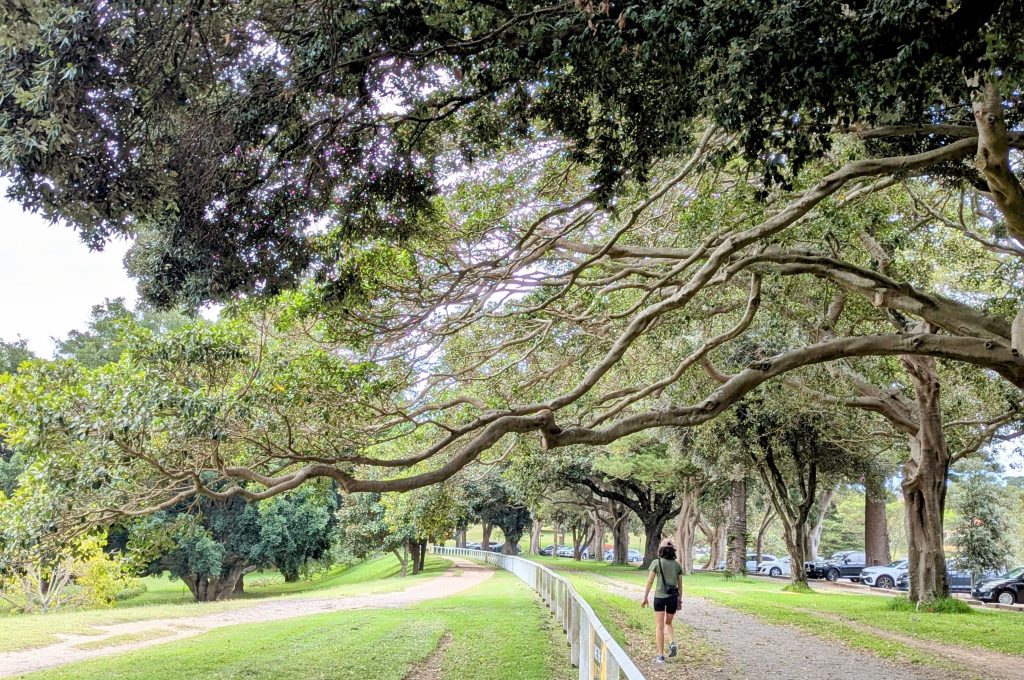
This practice can be down anywhere you have space to walk back and forth over a few feet. You can do it barefoot or with shoes on, indoors or outdoors, or even as part of your walking routine.
Walking at a very slowed down pace, bring your attention to sensations within your body with each step. You might notice yourself rolling through each foot, different muscles engaging, or subtle changes in your breath.
You can also widen your attention by becoming aware of the space you’re moving within, while still being connected to the movement of your body through this space.
Give yourself a few minutes with this practice, enough to settle into a slower, more aware rhythm.
If You Want to Modify It:
If walking isn’t accessible to you, you can adapt this to a seated position, mimicking walking with your feet or your hands. You can also visualize yourself moving through your space.
You can also use this practice of mindful walking for a portion of your walk, rather than the entire time. This can be a way to recalibrate your attention when you feel it’s needed.
There are plenty of times when I head out for a walk because I want to step away from all that’s on my mind and on my plate, only to find myself back in my head as soon as I’m out there. Using this strategy helps to bring me back to my body and my surroundings, without needing to slow down my entire walk.
Why I Use It:
Movement-based mindfulness exercises tend to be more accessible to people who find practicing in stillness challenging. Even for people who don’t struggle with stillness, adding movement can offer a different way of connecting with yourself and your surroundings.
Connecting to sounds around us is a simple way to reconnect with the present moment. I’m reminded of this whenever I travel somewhere where the sounds are distinct from the ones I experience at home. It naturally pulls my attention outward and helps me feel more connected to where I am. I try to remember this when I’m home also.
How to Do It:
You’ll want to set aside 3-5 minutes (or longer) for this practice.
Start by finding a posture that allows you to be both alert and comfortable. Ground yourself to this moment by feeling the contact of your body with the surface that’s supporting you.
Then, bring your attention to hearing. Allow sounds to come to you, rather than searching for them. Notice as they arrive, change, fade, or linger.
If you find yourself labelling sounds, or getting pulled into them, try noting each sound as ‘hearing’ or ‘listening’.
Keep bringing yourself back to the experience of listening whenever you find your attention has drifted. (This is likely to happen many times.)
Take note of your awareness at the end of the practice.
If You Want to Modify It:
This exercise can also be done informally, or in the moment. Instead of setting aside time, you can connect with the sounds around you as you’re going about your day. For example, while in a meeting, shopping for groceries, or scrolling your phone.
If hearing is not available to you, you can use another sense instead – connecting with what you see, smell, touch, or taste in the moment.
Why I Use It:
Sounds are always there, and always happening in the present moment. And if there’s silence, that’s also something we can notice and connect to.
This is another practice I first experienced through the Mindful Self-Compassion program. This is partly a visualization practice, and the imagery really spoke to me the first time I tried it (and every time since then). If you’re someone who has a close relationship with nature, this one might resonate in a similar way.
How to Do It:
This is designed to be a standing practice, but can be done seated with the feet in contact with the ground (if possible).
The first place to bring your attention to will be your feet. To facilitate this, you may wish to wiggle your toes, shift your weight forward and back, or side to side. Take a moment to feel your feet connected to the ground, and any sensations that are there.
Then begin to imagine yourself as a tall tree, with roots coming out of your feet and into the soil below you. Picture those roots extending deep and wide into the soil, connecting with the roots of other trees.
From here, imagine a storm rolling through. Consider how this impacts the tree, such as how it challenges the trunk and branches, while the roots keep the tree grounded.
As the storm moves on, reconnecting back with your breath, before gradually ending the practice.
Take your time with each step of this visualization, allowing it to sink in.
If You Want to Modify It:
If connecting through your feet isn’t available to you, you can adapt this grounding mindfulness exercise through your hands – resting them on your thighs to create a similar sense of contact and grounding. Alternatively, you can use the connection of your pelvis with your seat.
Why I Use It:
The imagery in this practice is something I find I can take with me into my day. It reminds me that I can ground myself through the connection of my feet into ground, and that this connection can help me stay rooted when I’m being challenged, just like the deeply entrenched roots of a tree.
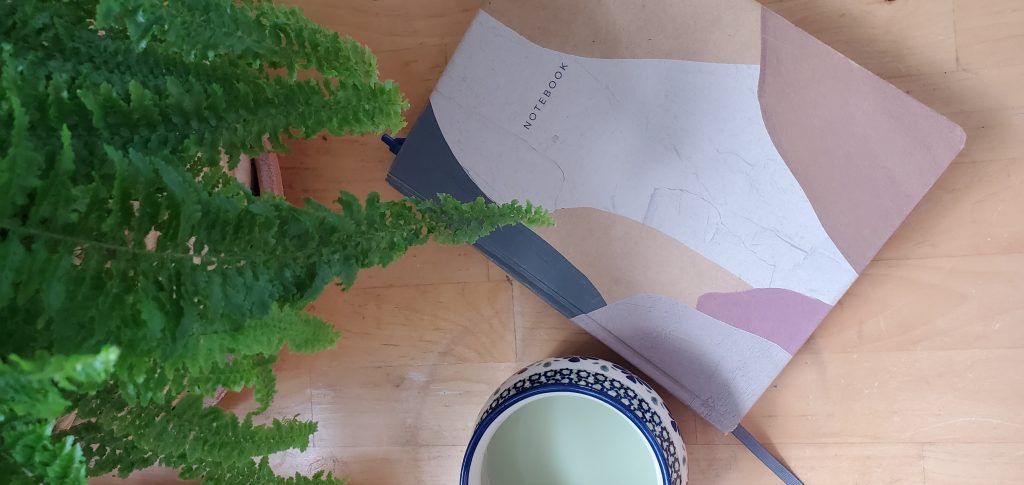
I find journaling sometimes gets misinterpreted as needing to look a certain way. What I would love more people to know is that you can make journaling your own, which is what this grounding mindfulness exercise is all about.
How to Do It:
Start by choosing a focus for your journaling. This might be:
i) what’s on your mind (aka a brain dump),
ii) what you’re feeling, or
iii) what you’re currently grateful for.
Why these 3 suggestions? Because:
i) letting things land on paper can open up space to be present;
ii) connecting to our emotions helps to ground ourselves, as does:
iii) realizing what’s already good (or great) in our lives.
How you write is completely up to you. Point form, full sentences, single words, pictures, diagrams – there’s no way to do this wrong.
If it’s helpful, here are some prompts you can work with:
On my mind: What can I let go of?
Emotions: what am I feeling right now? Where do I notice it in my body?
Gratitude: what feels supportive, nourishing, or meaningful in my life right now?
If You Want to Modify It:
If none of the above resonate, choose your own direction. The idea is to bring attention to what’s here in the moment for you.
Why I Use It:
Seeing words down on paper (or on the screen), makes them feel more real for me. It gives me space to acknowledge what is true in this moment, and opens up the opportunity to reconnect with what matters most to me.
Before You Move On...
Presence is a beautiful gift that we can offer others, and ourselves. But it’s often not the default way we move through a distracted world, so it is something that requires practice. In whatever way you choose to use these grounding mindfulness exercises, I hope that they help you spend more time in the present moment.
If you found these grounding mindfulness exercises helpful, you might like my 5-day series of one-minute mindfulness exercises. It includes guided versions of some of the same practices you read about here, a variation of the 5-4-3-2-1 exercise, as well as gratitude and mindful movement exercises. Each one is designed to be easy to follow along with, and to take into your day.
Subscribe below to receive the 5-day series into your inbox.