

I’ve heard many people comment recently about how they want to start practicing meditation regularly, but they find it hard to stick with. This is not uncommon with anything that can be uncomfortable at times, and doesn’t produce immediate results. Yet with the right conditions and a good understanding of meditation, the impact is well worth the discomfort and effort.
With that in mind, I’ve written this post about how to start practicing meditation to help you find your way into a more regular meditation practice.
We’ll explore what helps a meditation practice take root, from:
- clarifying your why,
- rethinking what meditation looks like,
- letting go of expectations,
- experimenting with duration,
- and more.
Whether you’re just starting, or returning to meditation after a break, I hope this post helps you approach your meditation practice with more clarity, curiosity, and compassion.
Getting Clear On Why You Want to Meditate
When considering how to start practicing meditation, this step is often undervalued.
Before you download an app or set reminders on your phone, I recommend pausing and asking yourself:
- Why do I want to meditate?
I strongly encourage you to take the time to reflect on this. Look past the generic reason, such as because you’ve heard it’s good for you. Or because everyone seems to be doing it.
Take the time to find your reason for wanting to meditate. Try to peel back the layers here. For example, you may come up with:
- because you’re tired of being constantly on edge, or
- because you want to respond to your kids or partner more calmly.
Both very valid reasons. But in order to truly root into your why, it’s valuable to look a little further by asking yourself:
- Why is being less on edge important to me? Or
- Why is it important to me to respond to my kids or partner more calmly?
Finding Your Core Reason
Be patient, as the reason may not come to you right away; it might take a few “why” questions to get to your core reason. I’m going to guess that it’s going to sound like something simple, yet it will be a profound reason that may be tied to a value you hold dear.
As a second step, it can be surprisingly powerful to write your why down somewhere where you’ll come across it often. Where that is will be personal to you.
These steps will help shift meditation from a daily to-do you need to tick-off, to something that supports what truly matters to you.
Stacking Meditation Into Your Day
Habit stacking is a well-known technique for making a habit stick. When people ask me how to start practicing meditation regularly, this is often one of the first things I mention.
I’m not familiar with who came up with the idea originally, but James Clear definitely wrote about it in his popular book, Atomic Habits. The principle of habit stacking is straightforward: pairing your new habit with a habit that’s already well-established in your life.
In the case of meditating, you might mediate right after:
- Your morning walk with the dog
- You close your laptop for the workday
- Loading the dishwasher after dinner
The nice thing about this technique is that the “when”, and to some extent the “where”, are already built-in, meaning there’s less to think about!
Clarifying the When and Where to Meditate
In order to figure this out for yourself, take some time to think about the parts of your daily routine that you’re most consistent with. Then choose the one that feels like the most natural fit for meditation.
Then get as specific as possible. For example, if you plan to meditate after your morning walk, decide where that will happen:
- Will it be on the mat in your exercise room?
- Sitting on a park bench before heading home?
If it’s after cleaning up the kitchen, will it be in the armchair by the window? Or lying on the couch?
It’s also worth thinking through how long you want to meditate for, and how you’ll access your meditation – an app, a saved recording, or simply setting a timer. I touch more on both of these in the sections below.
In summary, being intentional about these details takes out the guesswork and helps us to follow-through with bringing meditation into our lives.

Re-Thinking What Meditation Looks Like
If you’ve ever typed in “meditation” into Google, or even Canva, you’ve likely scrolled past hundreds or nearly identical images:
- Someone young, sitting crossed-legged and perfectly upright, hands resting on their knees, palms facing up, often in front of some idyllic nature scene,
- And, more often than not, that person is white.
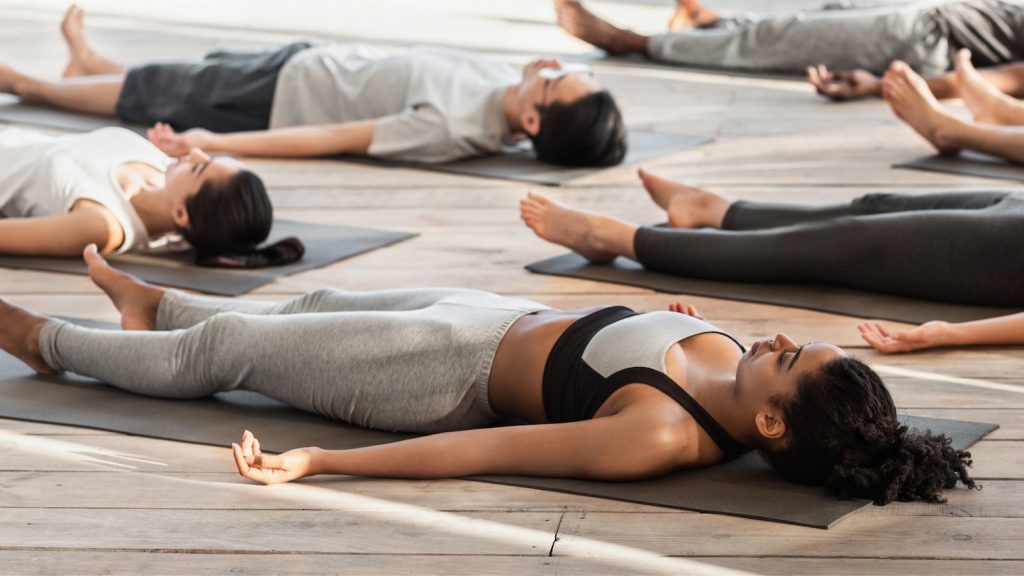
As far as position goes, meditation can be done sitting in a chair, lying down, standing, or even walking – or rolling, if you use a wheelchair.
And while meditating on a mountain-top or a white-sand beach sounds lovely, that’s not most people’s everyday. You can meditate anywhere:
- on a plane, in your kitchen, at your desk between meetings…
Who Gets to Meditate?
As for race and age, or any other marker of identity – meditation is for you! I recognize it’s not always as simple as this statement, of course. When the images we see don’t reflect us, or when meditation isn’t widely accepted in our culture or community, it can be harder to see ourselves meditating. This gap absolutely still needs attention.
Collectively, let’s forget the stock images that are already out there. If you were to upload a realistic image of yourself meditating to a search engine, what would it look like?
Think about your life and what feels most natural and accessible to you.
Incorporating Movement Into Meditation
Building on the last point about re-thinking meditation, it’s worth remembering that meditation doesn’t have to be performed in stillness.
Some meditations are specifically designed to be done in movement, such as mindful walking practices. In this type of practice, attention is directed to the sensations of each step, our breath, and the environment we’re moving within.
Beyond formal mindfulness practices, movement of any type can qualify as meditative when approached with the intention of being present. Maintaining our awareness on our body and our breath when exercising or doing a physical activity, can cultivate the same quality of awareness as a seated meditation.
Beyond Yoga and Pilates
It doesn’t have to be yoga or Pilates, typically labelled as mindful movement practices, to be meditative. What matters most is the intention and attention you bring to the moment during the activity.
The key is to be deliberate about it – to notice when you’re moving on autopilot rather than with mindful awareness.
If meditating in stillness is difficult for you, incorporating movement may be a good place to start.
I’ve written an in-depth post about mindful movement, which you can explore here.
Releasing Expectations Around Meditating
Similar to mindfulness, a common misunderstanding about meditation is that it’s meant to make us feel a certain way – calm, clear, focused, or grounded. While these experiences can happen, they aren’t the goal.
The real purpose of meditation is to:
- slow down and tune in to what’s present,
- connect with ourselves,
- practice being with whatever arises.
Some days this may feel peaceful, other days uncomfortable. Both are part of a meditation practice.
When we come into a meditation expecting a particular outcome, we set ourselves up for frustration. We might even think we failed if it didn’t unfold in the way we hoped.
Releasing expectations around meditating creates space for presence, curiosity and compassion. It allows you to meet yourself where you are, rather than striving to get to where you think you should be.
Over time, the shift from striving to noticing, from fixing to being, becomes the quiet and powerful transformation that meditating offers.
Finding the Right Length for Your Meditation Practice
The length of your meditations matter, but not in a “the longer, the better” manner.
The right duration will depend on you. What you’re hoping to cultivate, your lifestyle, your experience, will all help you determine what that amount is.
Some people need 20 to 40 minutes, while for others 5 to 10 minutes are enough. Keep in mind that a shorter practice doesn’t mean you’re less capable when you’ve intentionally settled on what works for you.
In my experience, I find the shorter practices more manageable for busy days, while the longer practices work well for when I can make more time. I also find that I gravitate to longer practices when I feel that it’s going to take me more time to settle into a practice.
Consistency Over Duration
Overall, consistency will be more important than duration when you’re figuring out how to practice meditation regularly. A shorter practice done regularly with genuine attention will always trump a longer practice done sporadically out of obligation.
Experiment with different durations and you’ll find what works for you.
Our Thoughts Are Not the Enemy
A common misconception about meditating is that we’re supposed to stop our thinking. It’s understandable why so many people hesitate to meditate when that’s the expectation.
But meditation isn’t about quieting our mind. It’s about becoming aware of our thoughts and learning to relate to them differently – with awareness and compassion.
During mindfulness meditations, our focus might rest on our breath, sensations in our body, or sounds around us. At some point – usually very quickly – our mind will wander. That’s not failure.
Each time we notice our attention has drifted and we gently return it, we’re strengthening awareness, and practicing not getting caught up in our thoughts. That’s actually the practice itself – noticing rather than reacting.
With repetition, meditating helps us:
- spend less time lost in thought and more time connected to what’s actually happening in the moment;
- see our mental patterns more clearly;
- soften our reactivity; and
- create space to respond with more understanding and care.
These are some of the most valuable skills meditation teaches us. They don’t come from silencing our mind, but noticing it and learning to work with it as it is.
Where to Access Meditations
Meditations can be accessed in so many different places. Choosing what works for you will require some experimentation and reflection.
A few common and well-liked apps are Open, Insight Timer, and Headspace. Many of the paid ones offer free trial periods, where you can explore which one resonates with you. Within these apps, you’ll find practices of different lengths, types, and voices.
Some common mindfulness meditation practices include:
- Body Scan – bringing awareness to sensations throughout the body
- Breath Awareness – focusing on the breath as an anchor for the present moment
- Mindful Walking – bringing awareness to your body in motion
- Self-compassion – cultivating kindness towards yourself
Aside from apps, other sources of meditation include:
- You-Tube channels
- Podcasts (such as 10% Happier)
- Community organizations (such as The Global Minds Collective)
- The websites of individual teachers (check out my free mindfulness meditations here)
It can be overwhelming to know where to start. But the most important thing is to start somewhere. When a source you try is not for you, you can check it off and move onto the next one. The right one(s) will reveal themselves as you go.
Your Next Move
I’m curious, what’s one thing you’re taking away from this post to support yourself in practicing meditation regularly? Even one small shift in thinking about meditation can get you well on your way to making meditation a routine activity.
It will take effort but when your reason for practicing is clear, and you’ve found an approach that feels realistic and meaningful, your practice will take root. Start where you are today.
Ready to start putting what you’ve learned into practice?
Explore meditation in small, manageable chunks. Subscribe below to receive 5 simple practices you can try in just a few minutes each day. This will help you experiment, find what works, and start building a meditation routine that fits in your life.