

I’ve written this blog post about making Pilates a mindful experience because I would love more people to understand that Pilates is not mindful by default. Simply showing up to teach or take a Pilates class doesn’t guarantee mindfulness. It takes effort and deliberate intention, for both instructors and participants, to create a mindful experience.
In this post, we’ll explore how both instructors and participants can bring mindfulness into Pilates – before, during, and after a class. My hope is that by the end, you’ll have a clearer sense of what it takes to make every Pilates session an opportunity for presence, awareness, and connection.
A Note On Why This Matters
Over the years as a Physiotherapist and Pilates Instructor, I’ve come to greatly appreciate the importance of taking care of my own health – not only my physical health, but my mental health as well. Without this, I know that I wouldn’t be able to show up effectively in these roles, or stay healthy doing so. For me, taking care of myself holistically has come together nicely through mindfulness, both as a practice as well as a way of living.
Lately, I’ve been reflecting on the growth that the Pilates industry is currently experiencing, and wondering how (and whether) instructors are being supported with taking care of themselves. Similar to the healthcare field, there seems to be a strong emphasis on learning new technical skills, and limited, if any, focus on showing or inspiring instructors to take care of themselves holistically. In my experience, I feel this is so important for longevity and fulfillment. Without it, it becomes evident in how we show up.
I’ve also noticed a shift in Pilates itself, moving away from its roots as a mindful movement practice, towards a greater focus on performance and aesthetics. I do think something valuable can get lost when the emphasis on awareness and presence is reduced. I would love to bring back more of that mindful approach to teaching, to help clients have an experience where they are connecting to their body, and moving for the sake of moving and being present.
And that’s how this blog came to be. I’m hoping to make Pilates a more mindful experience for everyone involved, as well as encourage instructors to use mindfulness as a way to take care of ourselves (or at least inspire their own meaningful way to take care of themselves).
When Instructors Embody Mindfulness
If, as an instructor, you want to create a mindful experience, it starts with understanding what mindfulness is. Read about it, watch videos, or better yet – take a course. But most importantly, practice it.
Mindfulness isn’t just a concept to be understood intellectually. It’s something we come to understand deeply through practice.
And when we practice it regularly, we embody it.
In other words, it shows up in how we move through the world. We become more present, more aware, and better able to meet each moment with care. This inevitably influences the way we teach.
How Mindfulness Shapes the Pilates Class Experience
When people come to a Pilates class, it’s because they’ve carved out rare time for themselves. When mindfulness informs how we teach, that time can become more than a workout. It can become an opportunity for participants to deepen their awareness and connection to themselves.
For example, instead of rushing from one exercise to another, we may slow down and give participants time to feel what’s happening in their body. We may allow for moments of silence during and between exercises, giving our clients the opportunity to tune in and observe their experience.
And rather than telling them what they “should” feel, or prescribing exactly when to inhale or exhale during a movement, we might invite them to:
- notice their breath,
- sense how their weight is distributed through their hands and feet in four-point, or
- observe where they feel muscles working.
Mindfulness can also be reflected in a moment of stillness before the first movement of the class:
- to feel the contact of the body against the ground, or
- to notice the flow of the breath.
Putting It Into Action
The exercises themselves don’t have to change. But the quality of attention we bring to the room, the words we use to cue, and the space we create for participants to notice their own experience, can shift the entire class. Clients will notice this, even if they can’t quite put their finger on why the class feels different.
A simple way to start exploring making Pilates a mindful experience is to take one or two familiar exercises, keep them as they are, but experiment with how you instruct them. Afterwards, reflect on how it felt for you as instructor, as well as how your clients responded.
It can also be helpful to notice this from the other side. When you’re taking a class yourself, pay attention to how it feels when you’re given more opportunity to tune in, versus when cues are more constant.
Setting a Mindful Tone
Making Pilates a mindful experience for our students begins before the class even starts. Mindfulness filters into how we hold space in a room as clients are settling in, and how we transition into a practice. It can be as simple as greeting our clients authentically, with full presence rather than a distracted hello. Even small choices, like pausing before starting to speak, signal that we’re fully here.
Mindfulness also shows up in how we guide clients into the first moments of practice. For example, being conscious of our tone and clarity when instructing them to grab equipment, or pacing directions thoughtfully as they move into the first position. These moments may seem minor, but they can set a mindful tone for the entire session.
Your Personal Mindfulness Practice Matters
Embodying mindfulness in our teaching becomes much easier when we practice ourselves on a regular basis. By “practice” here, I’m referring to a formal exercise, like a meditation.
A lot can happen in a day. Our personal lives, conversations with clients, or even the effort of teaching several classes in a row can pull us out of the present moment. Without some form of intentional practice, it’s easy to carry that mental noise and distraction into the room with us.
Formal mindfulness practices give us space to pause, observe what’s happening in our mind and body, and return to the present moment. Over time, this practice begins to carry into our day, including how we show up when we teach.
For this reason, it can be valuable to maintain a regular practice outside of teaching, while also finding small ways to centre yourself before your day begins, or between classes.
For instance, you might set aside 15 minutes for a guided body scan at home, and also take a minute between classes to simply observe your breath and reset before greeting the next group. If you prefer anchoring to something other than your breath, you can try:
- a couple of minutes of movement to anchor into your body;
- a brief body scan;
- connecting to your feet on the ground;
- a mantra like, “I am here”, to repeat to yourself a few times.
These mindfulness practices don’t have to be elaborate. What matters is that they resonate with you.
Practicing Mindfulness Through Movement
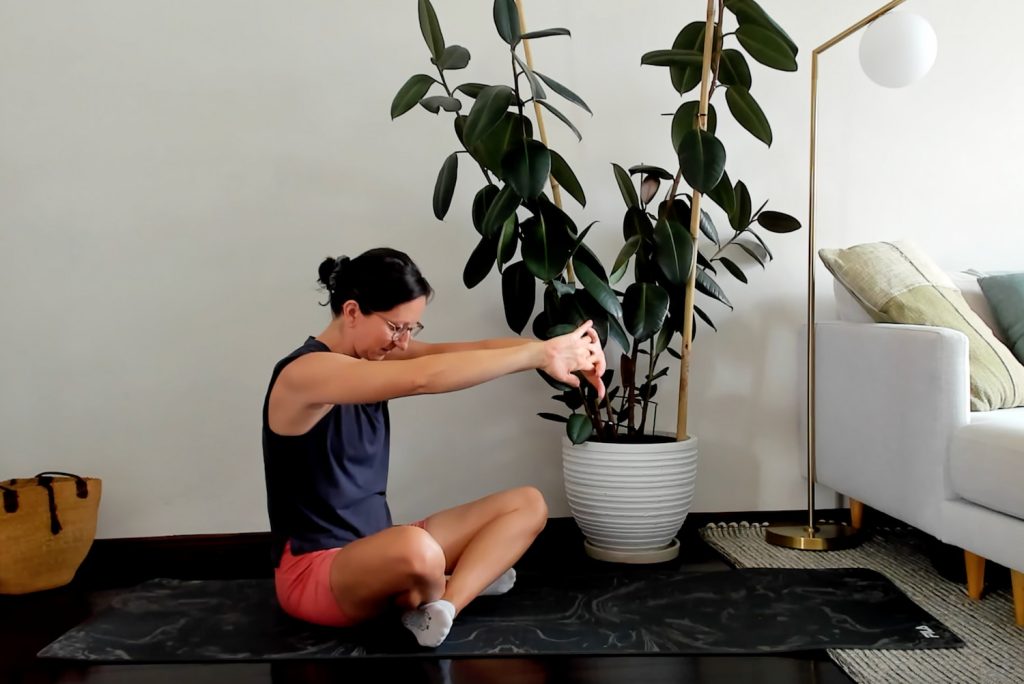
Another way to cultivate mindfulness is through your own movement practice. When you do Pilates yourself, or participate in other forms of movement, come in with the intention to be present.
When we’ve done the movements hundreds of times before, it’s easy to drift into autopilot. Or when we go into a class looking for exercise inspiration, the focus can drift away from the experience within our body. Notice when this happens, and gently bring your attention back to the experience of moving, such as:
- how your body is moving through space;
- how your breath changes throughout a class;
- where there’s ease and where there’s tension.
Pilates, in particular, offers so many opportunities to tune into these details.
When I take classes taught by others, particularly people that I know personally, my mind tends to slip into analysis mode: the cues, the sequencing, the pace. When I catch myself doing this, I try to release any judgement (towards myself for doing so and towards the instructor), and come back to my body; back to feeling the movement rather than analyzing it. It’s definitely a practice, and always will be.
Mindfulness For Your Longevity
I hope you’re starting to wonder: is this all for my clients’ benefit? Absolutely not.
Practicing mindfulness isn’t only about making our teaching better, or giving our participants a richer experience. It’s also for our own well-being.
Teaching can be physically, mentally, and emotionally draining. We might be teaching many classes a week, teaching on top of other work and family demands, or running a business in the background of it all. Over time, this can take a toll.
Pilates is often chosen because it’s a form of movement that people associate with longevity. It’s low impact, holistic, and includes a lot of variety. If we’re helping our clients work toward that kind of longevity, it’s worth asking whether we’re considering our own as well.
Practicing mindfulness can help us with this. Whether it’s a longer practice we set aside time for, or moments throughout the day when we check in with ourselves, mindfulness helps us notice and acknowledge how we’re feeling, and what we may truly need in a given moment. Tapping into this kind of awareness helps us respond with care, rather than pushing through stress or exhaustion.
For example:
- noticing when we need to step outside for some fresh air between classes;
- adjusting how much we physically demonstrate; or
- recognizing when we need to ask for a sub.
Over time, this kind of practice can make a real difference in not only how long we’re able to keep doing this work, but also how we feel doing it. And in a client-facing wellness role, that speaks for itself.
When Participants Practice Mindfulness
Pilates Isn't Mindful By Default
Pilates is often described as mindful movement, or involving mindfulness. And rightly so. It inherently draws attention to alignment, form, control, and breath. But simply attending a Pilates class doesn’t guarantee a mindful experience.
As described earlier in this blog post, instructors play an important role shaping the environment and experience for their participants. But even the most thoughtful cues and intentional pace can have little impact if we – as participants –are distracted or moving on autopilot.
So I can’t emphasize enough that Pilates class students also have a very vital role to play in making Pilates a mindful experience. This involves deliberately bringing our attention to our body as we move, rather than following instructions mechanically. Working at a pace that allows us to do this is also part of it. If we’re finding ourselves constantly rushing to keep up, a slower-paced class may be a better fit.
Bringing Your Attention to Your Body
Holding our attention on our body as we move might mean:
- feeling the sensations of muscles working;
- becoming aware of unnecessary gripping in the hands, shoulders, toes, or jaw;
- sensing the movement as it unfolds, rather than just reaching the end position, such as feeling what’s happening in the middle of a squat or roll-down, not only at the bottom or top;
- observing what’s happening with our breath;
- recognizing when we might need to modify a movement, or pause.
It also might mean bringing our attention beyond our body, such as:
- noticing how we’re relating to the way our body is moving;
- catching when our mind has wandered out of the room or when we’ve started comparing ourselves to someone else in the class, and
- treating ourselves with kindness throughout the practice.
Not all of this needs to happen at once. In reality, it’s more likely that we cycle through noticing different things. Overall, the practice is to notice when our attention has drifted, and to return, again and again, to what we’re doing and feeling.
Easing Into Mindful Movement
If this type of awareness is new to you, it can sometimes help to practice with simpler movement first, such as walking. You might try bringing this attention to your next walk outdoors, noticing the sensations of your feet on the ground, or your arms swinging at your side. Guided walking meditations, usually performed a bit slower than a typical walk, can also be helpful.
Some people will find it easier to practice with movement, while others will prefer to start in stillness. For the latter, body scan practices are another way to develop this kind of awareness before layering movement on top.
Start and End With Presence
Participants can also support a more mindful Pilates experience before the class even begins. If you anticipate the class being fast-paced from the start, and this makes it difficult for you to bring your attention inward, try arriving a few minutes early to create a moment to transition from whatever came before.
This could look like sitting in your car for a couple minutes, spending a few moments with your breath. Allowing yourself this small pause can make it easier to settle into the practice with more presence.
If your reality is that you’re often barely making it to the class on time, there may still be an opportunity to take a slower breath or two, either before you enter the room, or once you’re on your mat or reformer. Even this can help you make the shift inward.
The same can apply at the end of a class. Rather than rushing straight into wiping down equipment or moving onto the next part of your day, take a brief moment to notice how you feel after a class. This can help close the experience with the same awareness you brought into it.
Perfection is Not the Goal (for Pilates Participants and Instructors)
It can seem like perfection is the goal with the way Pilates is portrayed culturally these days.
As an instructor, you might feel the pressure – whether it comes from yourself or somewhere else – to deliver a flawless class. You may worry about sequencing, cues, timely modifications, or about how the class is being received.
As a participant, it’s easy to fall into the Pilates trap: thinking that you have to move perfectly, align meticulously, and sync your breathing flawlessly.
But perfection is not the goal. The goal is to move, to connect with your body, to work towards goals you have set for yourself, and to be present with the experience.
Striving for perfection can actually pull attention away from our body, blocking awareness. When we release it, we create space to be present with our movement, our breath, and our experience in the moment. In other words, it opens the door to a truly mindful experience.
Importantly, letting go doesn’t mean we ignore technique or our goals. It means we shift our focus from achieving an ideal to connecting with what’s happening right now.
Embracing Non-Striving in Pilates
One helpful way to do this is to embrace one of the core attitudes of mindfulness – non-striving. Non-striving means practicing presence for the sake of being present, not for any particular outcome.
In the Pilates context, it can mean teaching for the sake of teaching, and practicing Pilates for the sake of moving. It can take a little to wrap your head around this concept. But when you do, it can help you shift the focus to presence and the process itself, rather than being attached to perfection or outcomes. (I’ve written more on non-striving in this blog post.)
Mindfulness and Perfection
Even with mindfulness, we won’t be fully present the entire time. Whether we’re teaching or moving, our minds will drift, analyze, judge. We might rush through instructions or a movement sequence. It’s normal, we’re human afterall. The invitation here is to notice when this occurs, and gently bring ourselves back to the present moment.
Bringing It Into Practice
It’s one thing to read new information, and another to implement what you’ve learned into your life. So before you leave this post, I invite you to pause for a moment and consider:
What would make Pilates a more mindful experience for you?
- Maybe it’s arriving a few minutes earlier.
- Offering more moments of silence during a class.
- Paying attention to the midpoint of a movement instead of only the start or end.
Mindfulness in Pilates doesn’t come from doing everything differently. It comes from making small shifts where it feels meaningful to you.
If this way of approaching movement resonates with you, you might enjoy the reflections I share with my email community. I regularly write about mindfulness, movement, and the small ways we can bring more awareness into our everyday lives.
You can subscribe below.